
AI and Human Learning: A Double-Edged Sword
Published:
Artificial Intelligence (AI) has come a long way in mimicking the human learning process. From its ability to observe, imitate, and store information to analyzing vast amounts of data and finding intricate patterns, AI has reached impressive heights. With human-designed models, AI can reflect and adapt in ways that are undeniably sophisticated. However, despite these advances, there are fundamental differences between AI’s capabilities and the richness of human experience, learning, and adaptability.
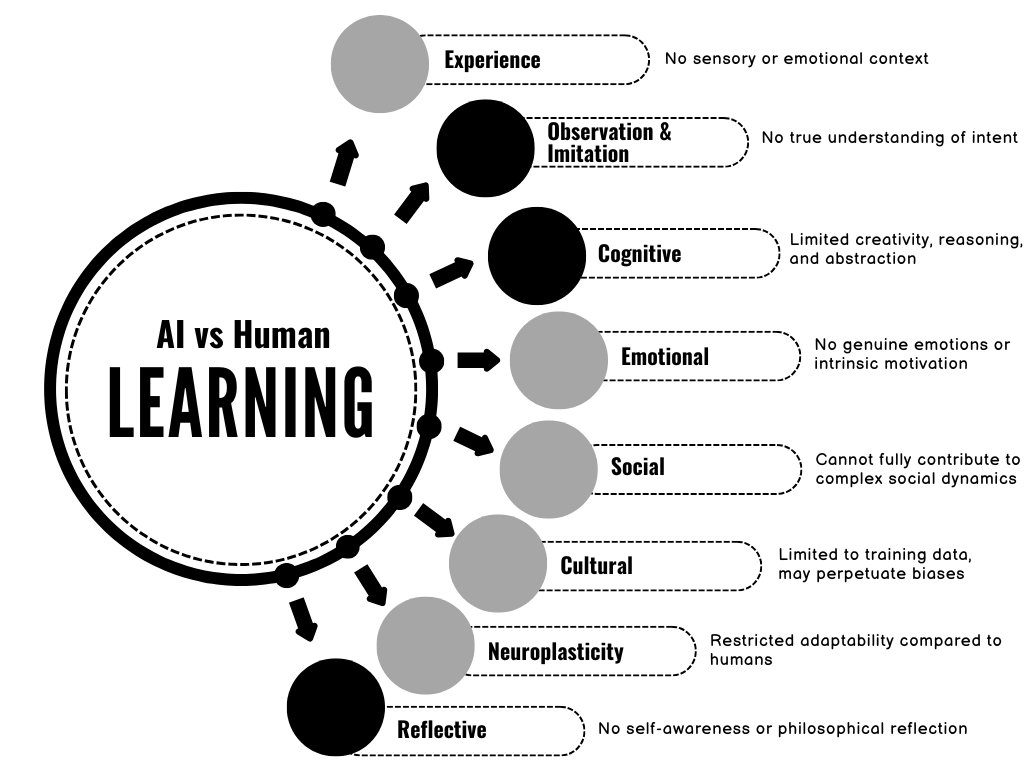
The Strengths of Human Learning Humans are unique in their ability to learn through real-world experiences. Our learning is shaped by sensory inputs, emotional responses, social interactions, and the environment in which we grow up. Whether it’s the classroom, the workplace, or simply nature itself, humans absorb knowledge in a deeply nuanced and context-specific way. Additionally, neuroplasticity—the brain’s remarkable ability to change and adapt—allows us to rewire ourselves in response to new information, challenges, or experiences.
AI, by contrast, lacks this rich, embodied experience. It doesn’t sense the world, doesn’t experience emotions, and doesn’t interact socially like humans do. AI’s observations are devoid of meaning, intent, or the self-awareness that comes with human consciousness. It does not have curiosity or motivation to learn for the sake of learning. Moreover, AI’s adaptability is restricted by the algorithms humans create for it, leaving little room for true flexibility or personal growth in the way humans experience.
The Gaps AI Faces While AI excels at processing information and recognizing patterns, it is inherently limited in several crucial areas. Without real-world experiences, it cannot grasp context in the same way humans do. Human nuances—such as cultural, emotional, or social contexts—are largely lost on AI. This lack of understanding creates a gap in the way AI processes and reacts to human situations, making it difficult for AI to offer the same depth of insight and judgment that a human could.
Another issue is the inherent limitations in AI’s plasticity. Unlike humans, who can continuously adapt and rewire their brains through experiences, AI is confined by the algorithms that underpin it. These algorithms are, ultimately, a product of human design, limiting AI’s capacity for true innovation or transformation beyond what it has been programmed to do.
Challenges and Ethical Considerations As AI continues to evolve, it brings about new challenges and ethical concerns that humans must navigate. One of the key issues is skill atrophy. As AI tools take over tasks like problem-solving, writing, and calculation, humans risk losing the very skills they once relied on to thrive. This dependency on AI for routine tasks could erode creativity, critical thinking, and problem-solving abilities over time.
Another pressing concern is privacy. With AI systems constantly collecting and analyzing personal data, individual freedoms may be compromised, and the risk of bias or discrimination is heightened. Since AI systems are trained on existing datasets, these biases can be ingrained and perpetuated, leading to unfair outcomes in decision-making processes.
Moreover, AI lacks the human judgment that is often necessary to make decisions that involve complex moral or ethical considerations. This is particularly concerning when AI is used in sensitive areas, such as healthcare or criminal justice, where decisions can have life-altering consequences.
The rise of deep fakes is another issue—AI’s ability to create realistic but entirely fabricated content can be used to manipulate public opinion or spread false information, causing widespread harm. The absence of accountability for these actions poses further ethical dilemmas.
Additionally, AI’s environmental footprint cannot be ignored. The rare earth materials required to build AI systems have significant ecological implications, and AI’s consumption of energy is growing at a rapid rate. Furthermore, not everyone has equal access to these powerful tools, leading to a digital divide that could exacerbate inequality.
The Potential of AI in Education Despite these challenges, AI offers tremendous potential for transforming the way we learn. By personalizing learning experiences, AI can cater to individual needs, allowing students to progress at their own pace. Intelligent tutoring systems can provide immediate feedback and assessment, helping learners understand concepts more deeply.
AI can enhance accessibility for students with diverse learning needs, providing tailored resources and support. It can assist educators by automating administrative tasks, allowing them more time to focus on teaching. AI can also foster engagement through gamification, making learning more interactive and motivating.
Through learning analytics, AI can track students’ progress and help identify areas where they may be struggling, enabling timely interventions. Collaboration tools powered by AI can also create opportunities for global learning and the sharing of knowledge across geographical and cultural boundaries.
Moreover, AI’s ability to facilitate lifelong learning is one of its most promising features. By offering low-cost, scalable platforms, AI can reach remote and underserved communities, democratizing education in ways that were previously unimaginable.
Conclusion: Striking a Balance AI has the potential to revolutionize learning, making it more personalized, accessible, and scalable. However, as we integrate AI into our daily lives and educational systems, we must remain aware of the limitations and ethical implications. The key will be finding a balance—leveraging AI’s strengths while also acknowledging the irreplaceable value of human experience, judgment, and adaptability.
By addressing the challenges of skill atrophy, privacy, bias, and environmental impact, and by ensuring equitable access to AI, we can create a future where AI complements human learning rather than undermines it. AI has the potential to empower us, but only if we guide its development responsibly and with foresight.