
Unveiling the Dimensions of Product Differentiation Strategies
Published:
In a crowded market, product differentiation is the key to standing out and winning customer loyalty. However, differentiation is not a single-point solution; it operates across multiple vectors, each representing a continuum of opportunities.
Richard Rumelt: “Identify a unique strength that your company/product has that aligns well with the current opportunities in your environment. Then leverage that strength in a way that others cannot easily replicate. Focus on what sets you apart and use it to create a sustainable competitive advantage.”
Let’s explore the five dimensions of product differentiation strategies illustrated in the accompanying diagram.
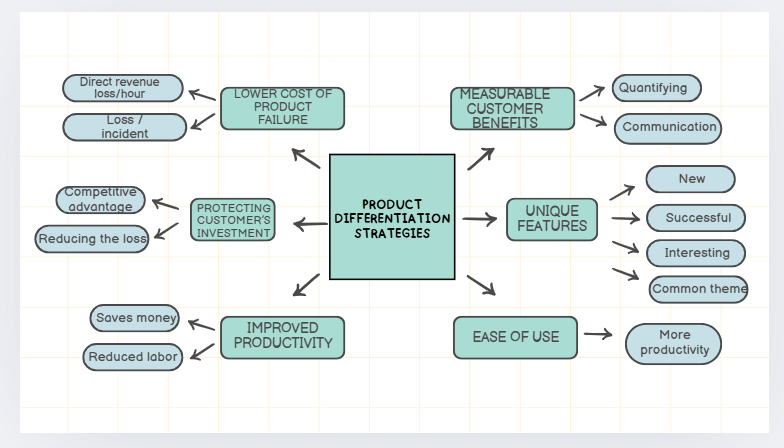
1. Lower Cost of Product Failure
This vector revolves around reducing the financial impact of failure for the customer. On one end, it targets direct revenue loss per hour, and on the other, it addresses the costs associated with incidents. Products designed to minimize the risk of downtime or mitigate failure-related costs offer a compelling value proposition for businesses focused on reliability and resilience.
2. Measurable Customer Benefits
This dimension emphasizes quantifiable advantages that customers derive from a product. It spans from effective communication of these benefits to showcasing measurable improvements, such as productivity gains or cost savings. Products that clearly articulate and prove their value tend to resonate deeply with their audience, building trust and adoption.
3. Unique Features
Uniqueness drives differentiation when executed well. The spectrum here ranges from introducing entirely new capabilities to refining existing ones in successful and interesting ways. A common theme often emerges, tying unique features to enhanced functionality or desirability. These innovations need to be compelling enough to shift customer preferences.
4. Ease of Use
This vector highlights the usability of a product, extending from intuitive design to enabling higher productivity through streamlined operations. Products that reduce complexity not only improve the user experience but also help customers achieve more with less effort, fostering loyalty and satisfaction.
5. Protecting Customer’s Investment
Products that protect customer investments provide a competitive edge. This dimension spans competitive advantage to reducing losses associated with product lifecycle or operational mishaps. Solutions that safeguard the customer’s resources build trust and long-term relationships.
6. Improved Productivity
Lastly, the productivity vector underscores solutions that enhance efficiency. From saving time and money to reducing labor-intensive processes, this dimension aligns closely with businesses looking to optimize operations. A focus on productivity not only makes a product indispensable but also helps justify its cost.
By understanding and leveraging these differentiation vectors, businesses can craft products that not only meet but exceed customer expectations across multiple dimensions. This strategic depth ensures a stronger market position and enduring customer relationships.