
Growth through Innovation: Lessons from AI and Machine Learning
Published:
Growth through Innovation: Lessons from AI and Machine Learning
Innovation is the driving force behind technological progress, helping industries solve pressing problems, seize opportunities, and prepare for the future. Let’s explore how innovation in the AI and machine learning (ML) space mirrors the three growth pathways: Technology-driven, Opportunity-driven, and Prediction-driven.
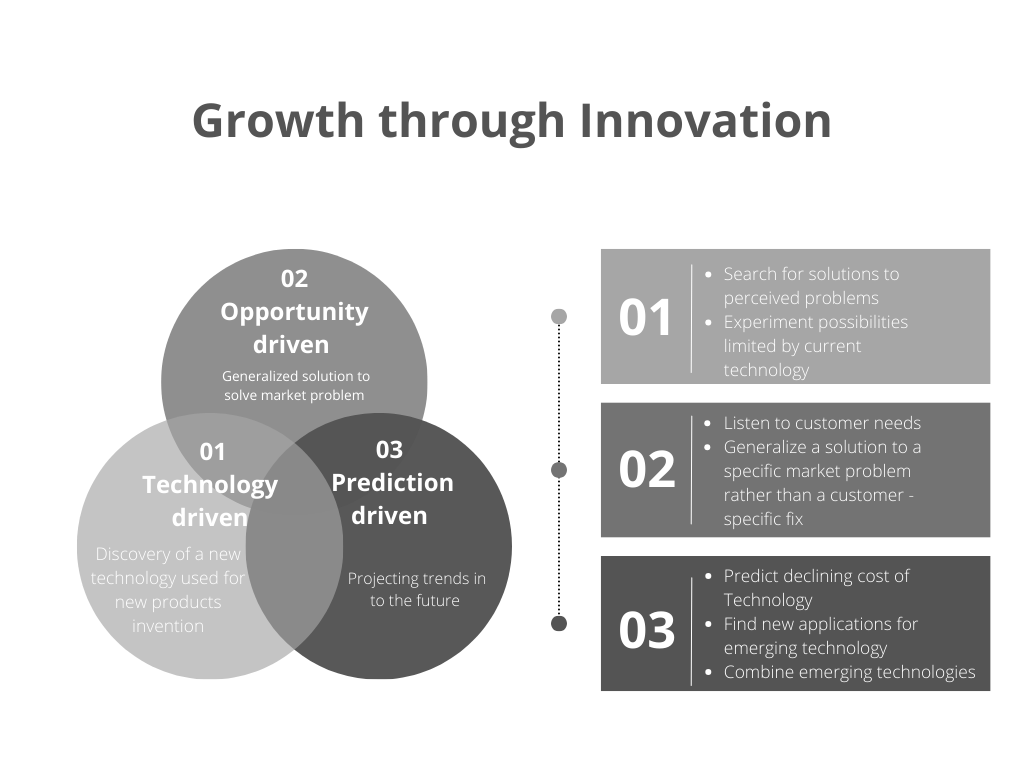
01 Technology-Driven Innovation This type of innovation originates from breakthroughs in technology that pave the way for new applications. In AI, the discovery of neural networks and deep learning frameworks like TensorFlow and PyTorch exemplifies technology-driven growth.
Example: The rise of generative AI has its roots in advancements like Transformer architectures (e.g., GPT, BERT). These breakthroughs led to applications in text generation, image creation (e.g., DALL·E), and even drug discovery through molecular property prediction.
Key Approach: Search for solutions to perceived problems using cutting-edge technology.
Experiment within the possibilities offered by the current state of technology.
Impact: The leap in generative AI capabilities is reshaping industries, from automating creative content production to generating new protein structures for pharmaceuticals.
02 Opportunity-Driven Innovation
Here, the focus shifts to listening to customer needs and generalizing solutions to market problems, rather than creating fixes for specific cases.
Example: Take customer personalization in e-commerce. Companies like Amazon and Netflix use recommendation engines powered by AI to understand user preferences and deliver relevant suggestions. This general solution addresses a market-wide problem of improving customer retention and satisfaction.
Key Approach: Listen to customer needs.
Develop generalized solutions applicable to a broad range of problems.
Impact: Opportunity-driven AI innovations have made personalized experiences standard across industries like retail, entertainment, and education. From chatbot assistance to tailored financial advice, these solutions create consistent value.
03 Prediction-Driven Innovation
Prediction-driven growth involves projecting future trends and aligning technology development with them. This type of innovation thrives on identifying declining costs of existing technologies and combining them for new applications.
Example: Autonomous vehicles are a prime example. Companies like Tesla, Waymo, and others have capitalized on the predicted decline in costs of sensors, processors, and edge AI capabilities. By combining technologies such as computer vision, LIDAR, and real-time decision-making algorithms, they are building the future of transportation.
Key Approach: Predict technology cost trends.
Find novel applications for emerging technologies.
Combine multiple technological breakthroughs to solve complex problems.
Impact: Prediction-driven AI is steering the world toward more efficient and sustainable systems in transportation, agriculture, and energy management.
Conclusion: AI and ML as a Case Study for Innovation AI and ML vividly demonstrate how the three innovation pathways can complement each other:
Technology-driven: Discoveries in deep learning frameworks gave us tools like GPT and DALL·E.
Opportunity-driven: Personalization algorithms redefined customer experiences across sectors.
Prediction-driven: Autonomous systems and edge AI leveraged declining costs to transform industries.
By balancing technology breakthroughs with market opportunities and foresight, AI innovators continue to solve problems and create value at an unprecedented pace.