
Transition framework from using AI to creating
Published:
How start creating AI?
Empowering youth and educators to transition from AI users to AI creators begins with a solid foundation in core skills like mathematics, logic, and problem-solving. By introducing mathematical concepts from the basics in schools—such as algebra, geometry, and probability—students develop the analytical thinking required to understand the underlying principles of AI. Early exposure to computational thinking and problem-based learning fosters curiosity and prepares students to grasp more advanced concepts.
At the university level, this foundation expands into specialized fields like linear algebra, calculus, and statistics, which are essential for understanding machine learning algorithms and neural networks. Courses in programming, data science, and artificial intelligence provide the tools and techniques needed to design and develop AI systems. This educational journey builds perspective, showing students and teachers how mathematics transforms into practical AI solutions for real-world problems.
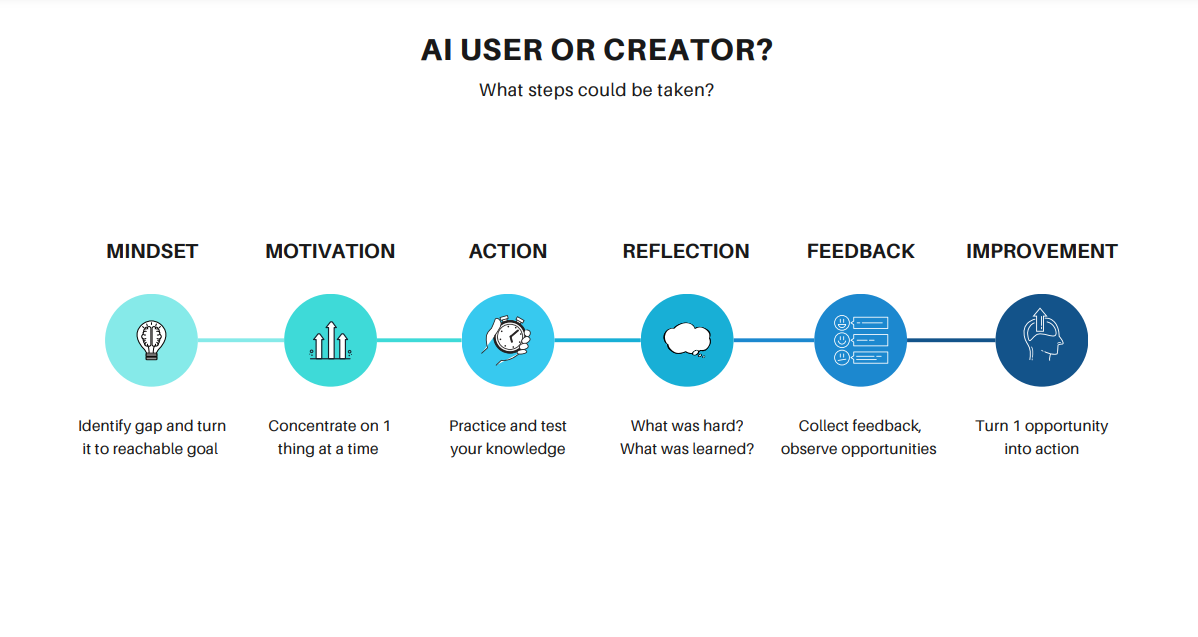
The transition framework emphasizes Mindset, helping learners identify knowledge gaps and set achievable milestones; Motivation, encouraging focus on mastering one concept at a time; and Action, where students actively practice coding and building simple AI projects. With Reflection, they analyze challenges and successes, while Feedback fosters collaboration and growth. Finally, Improvement transforms their ideas into impactful AI innovations.
This process not only builds technical skills but also cultivates creativity and problem-solving abilities. By starting with mathematics at school and advancing through higher education, students and teachers can confidently transition from passive users of AI tools to active creators, shaping innovative solutions for a rapidly evolving AI-powered world.